
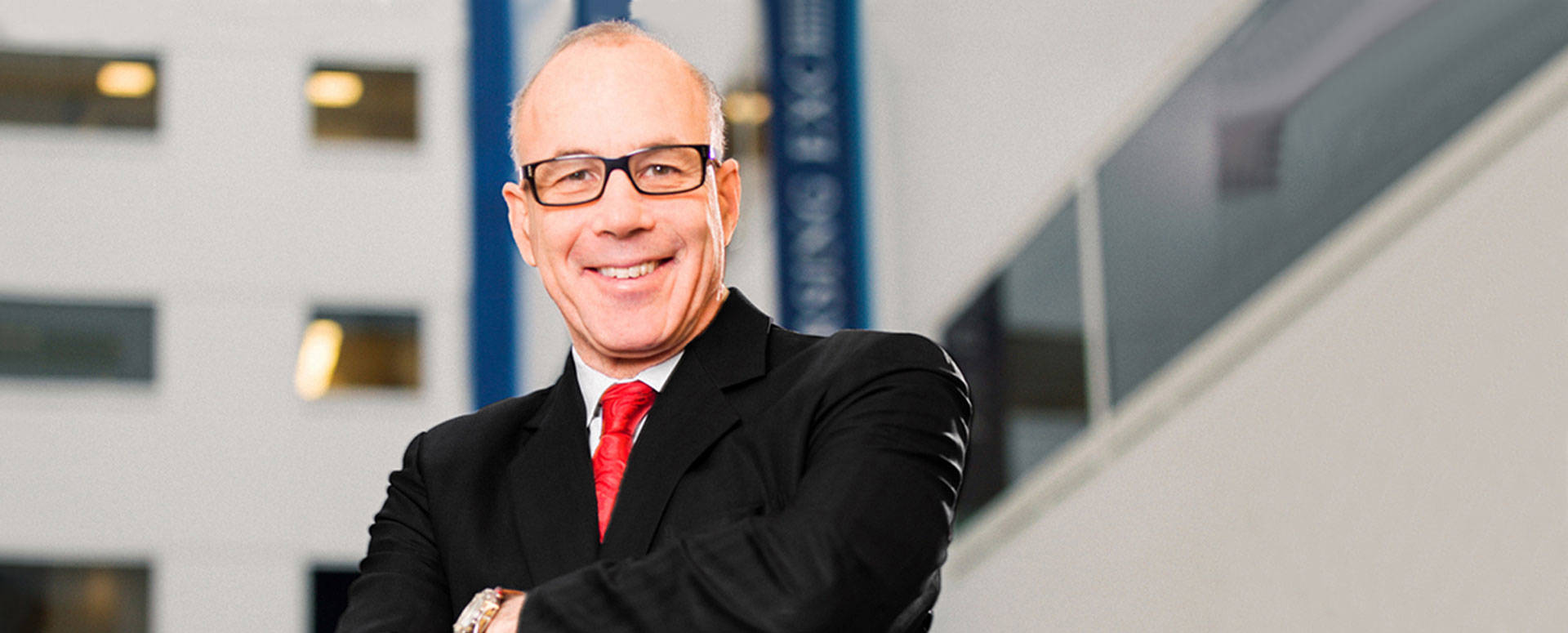
Stephen Klasko
Former President of Thomas Jefferson University & Former CEO of Jefferson Health
Stephen Klasko
Former President of Thomas Jefferson University & Former CEO of Jefferson Health
Check Fees And Availability for Stephen Klasko
Biography
Dr. Stephen K. Klasko is a healthcare innovator who thrives at the intersection of Silicon Valley and medical academia. As the former President and CEO, he transformed Thomas Jefferson University & Jefferson Health from a $1.8 billion regional player into a $10 billion healthcare empire. He pioneered the audacious merger between a health sciences university and a nationally ranked design school, proving that healthcare’s future lies in creativity as well. Jefferson Health was named the nation’s fastest-growing academic medical center.
Since leaving Jefferson, he has served as a Catalyst Advisor and as North American Ambassador to the global Future of Health (FOH) network. His board leadership spans NYSE’s Teleflex (as Board Chair of the $7 billion medical device entity) and NASDAQ’s DocGo (as Board Chair), plus a portfolio of cutting edge startups, including Globo, Amplify MD, Hippocratic AI, AIDOC, CraniUs, Paradigm, Oova, and Agentis, that are reimagining healthcare delivery.
Klasko, a recent Presidential appointee to the National Board of Education Sciences and former Dean of two medical colleges (University of South Florida and Drexel), has spent decades dismantling artificial barriers between high-tech innovation and high-touch care. His visionary leadership earned him recognition as #2 in Modern Healthcare’s “100 Most Influential People in Healthcare,” tied with industry titans Tim Cook and Jeff Bezos, and #21 in Fast Company’s “100 Most Creative People in Business.”
As a prolific author whose works range from serious healthcare manifestos to satirical children’s books, Klasko’s intellectual influence extends far beyond the page. His groundbreaking UnHealthcare: A Manifesto for Health Assurance (2021), co-authored with General Catalyst’s Hemant Taneja, not only diagnosed healthcare’s problems but also sparked a movement that directly inspired General Catalyst’s health assurance fund and led to the creation of HATCO (Health Assurance Transformation Company). His upcoming Hitchhiker’s Guide to the Healthcare Galaxy (2026) promises to be his most provocative yet, a time-traveling romp through healthcare’s future that shows how the collison of radically different universes can fix America’s fractured system. His recent Patient No Longer: How YOU Can Lead the Consumer Revolution in Healthcare (2025) and Feelin’ Alright: How the Message in the Music Can Make Healthcare Healthier (2023) uncover profound insights in unexpected places.
While professionally, Dr. Klasko is an MD/MBA/honorary doctorate holder who chairs the CEO Council of the American Cancer Society, he also moonlights as an active DJ spinning sets from Miami to Las Vegas, a fitting metaphor for someone who has made a career of mixing seemingly incompatible worlds into something entirely new. Klasko approaches everything with the same philosophy that has defined his healthcare revolution: th emost interesting solutions emerge when you refuse to accept that different world can’t work together.
Dr. Klasko holds a B.S. from Lehigh University, an M.D. from Hahnemann University, an M.B.A from the Wharton School, as well as an honorary doctorate (D.Sc.) from Fairleigh Dickinson University.
Speaker Videos
Disrupting Medical Education in the Age of AI
The Marriage Between Healthcare and Technology
TEDTalk: What Will Healthcare Look Like in 2030
Creating Renaissance in Healthcare
The Future of Healthcare: Telehealth and Communication
How to Transform to a Better Healthcare System
On Obamacare
Speech Topics
What Will Healthcare Look Like in 2030-The Courage to Change: Lessons From the AI Revolution for Educating Human Beings
Unintended consequences are not unintended if you know they are going to happen. Stephen K. Klasko, M.D., M.B.A., is the former President of Thomas Jefferson University and CEO of Jefferson Health who is now an executive at the country's leading generative AI venture capital firm and is on President Biden's National Board of Education Sciences. He has advocated for transformations in healthcare and education that encourage responsible AI and embrace a radical collaboration between human, computer and generative AI in educating the next generation of Americans incorporating the best in human design thinking and creativity with the amazing advances in large language model education sciences. He will discuss the good, bad and ugly of these new technologies as well as his success in transforming the selection, education and diversity of students in a variety of fields.
The Courage to Change: A Soundtrack (for Leadership)
If there’s anything I’ve learned in 40 years as a dean, CEO and president, it’s that we each need our own toolbox for an optimistic future. I recently retired as president of Thomas Jefferson University and CEO of Jefferson Health to pursue my passion for using technology to reduce costs and address health disparities. As I step away from a career as dean of two medical schools, CEO of three academic health systems and president of a university, these are my reflections on that toolbox for optimism. My message to you: Make sure your toolbox is full. My toolbox has always included music.
I’ve been a DJ for 50 years and a doctor for 40 years, so every Friday during the pandemic, I sent a playlist to our employees to remind them that art and music and humanity are still alive and well, despite the tough times each of us was experiencing. What I said repeatedly to my employees: We should listen to “The Message in the Music” (the O’Jays, lyrics by Philly’s own Kenny Gamble and Leon Huff). When I left Thomas Jefferson University and Jefferson Health, I gave an interview to the Philadelphia Business Journal based on songs in my toolbox, that I want to share with my colleagues and friends in the industry.
Is There an Avatar in the House?
The revolution that needs to happen in medical education and training to ensure that machine learning and computers become members of teams where the humans get to focus on the human questions.
Health Assurance in 2031: From COVID to Consumerism
This talk speaks to payor-provider alignment in the MA space.
It’s March, 2032. A mutant strain of an RNA encapsulated virus has been afflicting people in Australia. Of course, people old enough to remember, especially healthcare workers, the dark days of early 2020 and the COVID 19 crisis immediately panicked….for a second…and then they smiled. Because they knew healthcare had evolved from a broken, fragmented, expensive, inequitable “sick care” system to a “health assurance” system where there is payor-provider alignment and much of a patient's care happens at home.
We are witnessing healthcare’s “Amazon moment.” If you are a provider and think you’re going back to a business model solely based on hospital revenue and not relevant to people who want care at home, you will be out of business. If you are an insurer and think you can just be the middle man between the hospital and the patient, you’ll be irrelevant. If hospitals believe that innovation can just be this cute little thing that they do in the background, but the real business is getting “heads in beds” they will never recover from the pandemic of 2020-2022 losses. This keynote will highlight several post pandemic strategies, including:
1) New creative partnerships between community partners, health systems and payors as we move from “sick care” to “health assurance.” The fragmentation between payors and providers was replaced by a "radical collaboration through vehicles such as Medicare Advantage
2) The fastest growing demographic, seniors, redefined health provision through demanding and receiving healthcare in an understandable and connected manner. We will cite the results of the first "patient owned, primary care driven health system in a large senior community."
3) How providers handle data today will make or break patient trust in the future.
4) Technology can start to address health disparities but it must be applied strategically.
5) The most prized skills for physicians will be empathy, communication and self-awareness in the digital age.
6) How population health, predictive analytics and social determinants move from philosophy to the mainstream of clinical care, payment models and medical education.
Why The Digital Revolution Cannot Simply Make the Wealthy Healthier
Technology gives us an unprecedented opportunity to bridge the divides that threaten our society – if we have the determination to make it happen.
Pandemic of 2030: From Covid to Consumerism
Dr. Stephen Klasko tells a “history of the future” as governments in 2030 face a new pandemic. The talk will discuss how the pandemic of 2020 made clear the need for transformation in American health care delivery, including the fight to end health disparities, the growth of consumerism, and the shift from sick care to health assurance.
Putting Patients First
An obstetrician who also has an MBA from Wharton, Stephen Klasko has no trouble thinking about healthcare through a business lens. “With AI on the horizon, training humans to be better robots doesn’t make sense,” says Stephen Klasko, CEO of Philadelphia’s Jefferson Health. “The doctor of the future needs to be self-aware and empathetic.” By merging Thomas Jefferson University, a med school plus health and nursing colleges with design-focused Philadelphia University, Klasko has created the first medical school in the U.S. to offer a design certificate within its MD program. This now encourages future doctors to discover novel methods for putting patients first. Klasko has become one of the most innovative people in healthcare, developing new initiatives such as “hotspotting,” where med students are paired with patients who tend to overuse the ER, coaching them on self-care skills. The program has helped reduce unnecessary ER visits by 60%. “Virtual rounds” allow families to sit in, via videoconferencing software, when the doctor visits a recovering patient. Eighty percent of Jefferson’s doctors are trained in the network’s telehealth platform that offers 24/7 patient assistance.
Testimonials
Books & Media
Books
UnHealthcare: A Manifesto for Health Assurance
Bless This Mess: A Picture Story of Healthcare in America
We Can Fix Healthcare: The 12 Disruptors that will Create Transformation
We CAN Fix Healthcare - The Future is NOW
The Phantom Stethoscope: A Field Manual for Finding an Optimistic Future in Medicine
Media
2035 Taylor Swift presidency boosts healthcare! HIMSS26 keynote speaker explains
Related Speakers
)
)
17th Surgeon General of the United States, Chief of Health Innovations, Canyon Ranch & Distinguished Professor, University of Arizona and Ohio State University
)